MEDICAL APPLICATION
Isolator Biodecontamination
Phase-managed hydrogen peroxide delivery for pharmaceutical isolators, RABS, and transfer chambers — using ultrasonic atomization to control what happens to a droplet between the nozzle and the surface, rather than chasing the smallest possible droplet.
The Challenge
Hydrogen peroxide biodecontamination of an isolator is usually approached in one of two ways: flash-vaporize aqueous H₂O₂ outside the enclosure and inject the vapor, or atomize it inside the enclosure with two-fluid jet nozzles driven toward the smallest droplet the nozzle can produce — often a sub-3 µm target. Both treat droplet diameter as the governing design parameter. But efficacy in a real enclosure is set by the interaction of H₂O₂ concentration, water vapor, temperature, relative humidity, airflow, surface temperature, adsorption and desorption, condensation, and dwell time — and published engineering analysis of these systems shows condensation and evaporation have to be modelled as integral parts of the process, not secondary effects. Chasing a smaller droplet also brings its own costs: high-pressure atomizing gas disturbs enclosure pressure control, and a process tuned to fully evaporate everything gives up the surface liquid phase that the microbiology literature says actually drives fast spore kill.
Our Solution
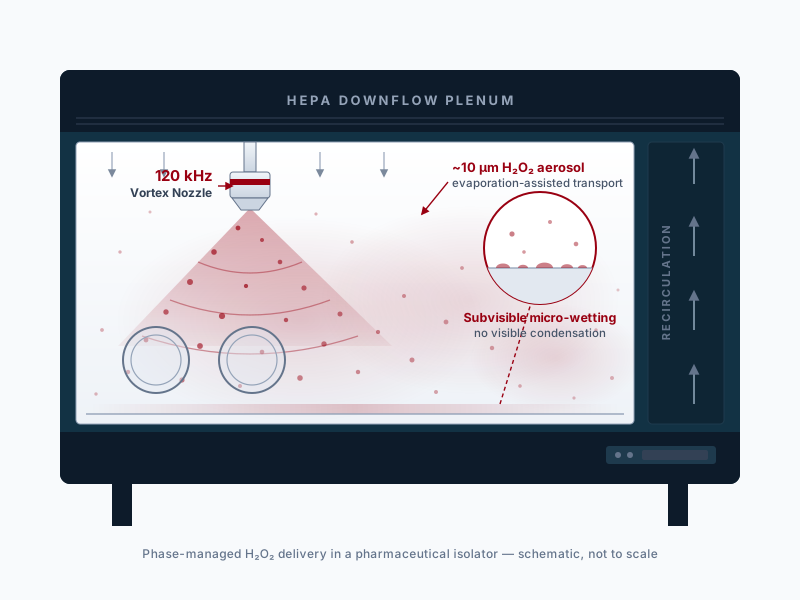
MicroSpray proposes a different question: not "how small can the droplet be?" but "what phase history should the droplet have between atomization and the surface?" A 120 kHz Vortex Nozzle atomizes H₂O₂ ultrasonically into a 10–25 µm distribution — no compressed gas doing the atomizing — and a low-pressure swirling sheath shapes that aerosol into a stable, wide cyclone that recirculating enclosure air can carry into corners, gloveports, and equipment shadows. From there the process is run as two deliberate regimes: droplets progressively evaporate in conditioned air while distributing (Mode I), then conditions shift so a controlled fraction reaches surfaces as a transient, subvisible peroxide film (Mode II). Liquid flow, droplet generation, air temperature, humidity, and air velocity all become independent control variables instead of being locked to one prescribed droplet diameter.
Controlled Micro-Wetting: Why a Perfectly Dry Cycle May Not Be Optimal
The strongest scientific argument for this approach is that complete evaporation is probably not required for rapid surface biodecontamination — and may not even be desirable. In a pharmaceutical study of H₂O₂ vapor conditions against biological indicators carrying more than 10⁶ Geobacillus stearothermophilus spores, Unger-Bimczok and colleagues found that subvisible condensation was required to achieve short inactivation times, while pushing further into visible condensation produced no additional sporicidal benefit. They identified molecular deposition of water and hydrogen peroxide onto the target surface as a determining factor in inactivation.
That result reframes the design target. Condensation is usually treated as binary — a dry surface or a wet one — but the biologically productive region sits between the two extremes: enough liquid-phase H₂O₂ at the surface to maximize antimicrobial contact, and not enough to create visible wetting, pooling, or unnecessary material exposure. A process engineered to eliminate all liquid gives up the very mechanism that makes the cycle fast; a process that floods surfaces pays for it in aeration time, material stress, and residual peroxide.
Ultrasonic atomization is well suited to operating deliberately inside that middle band, because droplet size is set by the nozzle's resonant frequency rather than by gas pressure. The intended droplet history is: roughly 10–25 µm at atomization, partial evaporation during transport, arrival at the surface as a smaller and more H₂O₂-rich droplet with low momentum, formation of a transient microscopic film, sporicidal contact, then desorption during aeration. Every stage in that chain is a variable the equipment can move — which is the point.
A Dual-Mode Delivery Strategy
The proposal is not simply a different nozzle. It is a phase-management strategy in which the same ultrasonic atomizer operates in different regions of the H₂O₂/water/air phase envelope at different stages of the cycle. Two complementary modes combine into a single sequence.
Mode I — Evaporation-Assisted Transport
The nozzle generates a 10–25 µm aerosol, and rather than requiring instantaneous evaporation at the nozzle, the thermal and mass-transfer conditions in the enclosure are set so the aerosol evaporates progressively during its residence time in circulating air. Critically, this must be treated as a binary H₂O/H₂O₂ evaporation problem, not as pure water: because water leaves an aqueous peroxide droplet preferentially, the droplet's diameter, temperature, peroxide concentration, and antimicrobial potential all evolve together in flight. That is an advantage rather than a limitation — a droplet does not need to still be 10 µm when it reaches a far corner of the enclosure. For initial development, moderate conditioning of the circulating gas is likely preferable to aggressively heating the peroxide reservoir; the air then supplies evaporation energy and transport at the same time.
References for this section
- The Engineering of Hydrogen Peroxide Decontamination Systems — S. Radl, S. Ortner, R. Sungkorn, J. G. Khinast, Journal of Pharmaceutical Innovation ()
- Vapor-Liquid Equilibrium. VIII. Hydrogen Peroxide–Water Mixtures — G. Scatchard, G. M. Kavanagh, L. B. Ticknor, Journal of the American Chemical Society ()
Mode II — Controlled Micro-Wetting
Once the sterilant is distributed, conditions shift toward controlled surface deposition — by changing injection rate, air temperature, relative humidity, airflow velocity, recirculation rate, or injection duration. The endpoint is subvisible microscopic peroxide deposition, not visible condensation. Because macroscopic condensation is avoided, the working hypothesis is that less liquid peroxide has to desorb during aeration; whether that translates into a shorter aeration step has to be demonstrated experimentally rather than assumed.
References for this section
- The Influence of Humidity, Hydrogen Peroxide Concentration, and Condensation on the Inactivation of Geobacillus stearothermophilus Spores with Hydrogen Peroxide Vapor — B. Unger-Bimczok, V. Kottke, C. Hertel, J. Rauschnabel, Journal of Pharmaceutical Innovation ()
Why 120 kHz Is the Advantageous Operating Point
Frequency, not air pressure, sets droplet size in an ultrasonic nozzle — a relationship established by Lang's capillary-wave work and exploited ever since. At 120 kHz the Vortex Nozzle produces a 10–25 µm distribution, which is the useful coincidence at the center of this proposal: it brackets the ~10 µm target the dual-mode concept is built around, and it sits inside the 10–20 µm band that recent modelling of aerosolized H₂O₂ transport in a pharmaceutical isolator examined directly. Dropping to 60 kHz gives 15–40 µm — a heavier aerosol that settles too fast for whole-enclosure distribution. Going finer than roughly 10 µm surrenders the surface liquid phase that Mode II depends on. 120 kHz is the point where the droplet is small enough to be carried by recirculation airflow and large enough to still arrive as liquid. The vortex head then does the second job: its swirling low-pressure sheath widens and stabilizes the plume so the aerosol reaches gloveports, corners, and equipment shadows, without compressed gas supplying the atomization energy.
References for this section
- Ultrasonic Atomization of Liquids — R. J. Lang, Journal of the Acoustical Society of America ()
- Model-Based Investigation of a Novel Decontamination Technology: Ultrasound Assisted Aerosolized Hydrogen Peroxide — M. R. Gaddem, Y. Hayashi, B. X. Scholz, H. Futamura, K. Kawasaki, H. Sugiyama, Chemical Engineering Research and Design () Open access · no paywall
The Combined Cycle
Phase 1 — Conditioning: establish chamber temperature, relative humidity, airflow pattern, and surface-temperature distribution, so the cycle starts from a known thermodynamic state. Phase 2 — Evaporation-Assisted Distribution: run the nozzles under conditions favoring partial evaporation, letting recirculation carry the aerosol everywhere before excessive localized deposition occurs. Phase 3 — Controlled Micro-Wetting: shift conditions toward subvisible surface deposition. Phase 4 — Dwell: hold the surface exposure needed for the validated biological endpoint — expressed as an exposure metric combining concentration, surface deposition, and time, not merely grams of peroxide injected. Phase 5 — Aeration: stop atomization and increase purge, catalytic treatment, and recirculation.
Why Ultrasonic Spray?
- ✓Droplet size set by frequency (10–25 µm at 120 kHz), not by atomizing gas pressure
- ✓No compressed gas supplying atomization energy — less disturbance to enclosure pressure control
- ✓Vortex sheath carries aerosol into corners, gloveports, and equipment shadows
- ✓Liquid flow, air temperature, humidity, and air velocity remain independent process variables
- ✓Targets the subvisible surface liquid phase the literature associates with fast spore kill
- ✓Avoids macroscopic condensation, pooling, and unnecessary material exposure
- ✓Low flow rates suit small enclosures — transfer chambers, pass-throughs, sterility-test isolators
- ✓Multiple small atomization points can be distributed through a large enclosure
- ✓Non-clogging titanium construction compatible with aqueous peroxide chemistry
Supporting Research
Peer-reviewed publications and technical literature relevant to this application area. Links open the publisher's site.
- Model-Based Investigation of a Novel Decontamination Technology: Ultrasound Assisted Aerosolized Hydrogen Peroxide
M. R. Gaddem, Y. Hayashi, B. X. Scholz, H. Futamura, K. Kawasaki, H. Sugiyama
Chemical Engineering Research and Design ·
Open access · no paywall
Models 10–20 µm H₂O₂ droplets in a pharmaceutical isolator — the size regime the 120 kHz nozzle targets.
- Decontamination of Geobacillus stearothermophilus Using the Arca Aerosolized Hydrogen Peroxide Decontamination System
L. B. Mead, T. Mathison, G. Osborne, A. M. Richards
PLOS ONE ·
Open access · no paywall
- The Engineering of Hydrogen Peroxide Decontamination Systems
S. Radl, S. Ortner, R. Sungkorn, J. G. Khinast
Journal of Pharmaceutical Innovation ·
- The Influence of Humidity, Hydrogen Peroxide Concentration, and Condensation on the Inactivation of Geobacillus stearothermophilus Spores with Hydrogen Peroxide Vapor
B. Unger-Bimczok, V. Kottke, C. Hertel, J. Rauschnabel
Journal of Pharmaceutical Innovation ·
The key result behind Controlled Micro-Wetting: subvisible condensation was required for short inactivation times, while visible condensation added nothing.
- Decontamination Assessment of Bacillus anthracis, Bacillus subtilis, and Geobacillus stearothermophilus Spores on Indoor Surfaces Using a Hydrogen Peroxide Gas Generator
J. V. Rogers, C. L. K. Sabourin, Y. W. Choi, et al.
Journal of Applied Microbiology ·
- Vapor-Phase Hydrogen Peroxide as a Surface Decontaminant and Sterilant
N. A. Klapes, D. Vesley
Applied and Environmental Microbiology ·
Open access · no paywall
- Vapor-Liquid Equilibrium. VIII. Hydrogen Peroxide–Water Mixtures
G. Scatchard, G. M. Kavanagh, L. B. Ticknor
Journal of the American Chemical Society ·
Recommended Equipment
Vortex Nozzle
The recommended configuration at 120 kHz — 10–25 µm droplets with a swirling low-pressure sheath that distributes aerosol throughout an enclosure without compressed-gas atomization
View details →Zero Air Nozzle
For enclosures where no added gas volume is acceptable at all: 12–15 µm at 120 kHz with zero atomizing air and near-zero flow rate
View details →Liquid Delivery
Pulse-free syringe metering of the peroxide feed, so injection rate becomes a clean, repeatable cycle parameter
View details →Common Questions from Research Groups
Is this a validated biodecontamination process?
No — and we won't present it as one. This is a proposed development pathway with a clearly stated hypothesis: that an approximately 10 µm ultrasonically generated H₂O₂ aerosol can provide effective isolator biodecontamination when the chamber environment is engineered to control the transition among airborne droplets, partially evaporated droplets, vapor, and subvisible surface liquid. The supporting literature is peer-reviewed and cited above, but biological D-values for a MicroSpray-based cycle would have to be established experimentally in your enclosure. We are looking for development partners, not making efficacy claims.
Why 120 kHz rather than a finer or coarser nozzle?
At 120 kHz the Vortex Nozzle produces a 10–25 µm distribution. That is deliberately chosen: it is light enough to be carried by recirculation airflow rather than settling out near the nozzle, and still coarse enough that a fraction of the aerosol arrives at surfaces as liquid — which is what Controlled Micro-Wetting depends on. At 60 kHz the same nozzle gives 15–40 µm, which settles too quickly for whole-enclosure distribution. Because ultrasonic droplet size follows frequency rather than gas pressure, the size band stays put when you change flow rate, which is what makes it a usable process variable.
How would a development program be staged?
Physical transport first, biology second. Stage I characterizes the actual droplet distribution of your peroxide formulation — D10, D50, D90, and D99, not just a nominal mean, since the large-droplet tail disproportionately drives localized deposition. Stage II measures droplet distributions at increasing distances from the nozzle (for example 50, 150, 300, 600, and 1,000 mm) while varying concentration, liquid and air temperature, humidity, airflow, and injection rate, to build an empirical evaporation relationship instead of assuming complete evaporation. Stage III places representative materials — 316L stainless, glass, glove materials, elastomeric seals, polymer tubing — throughout the chamber and measures deposited H₂O₂ per unit area, uniformity, film persistence, and whether visible condensation appears. Only then do biological indicators go into the worst-case locations.
What should we measure to compare this against our current cycle?
Not droplet diameter on its own. A meaningful comparison covers H₂O₂ consumed per cycle, BI log reduction and D-value, the full droplet distribution, surface H₂O₂ deposition, spatial coefficient of variation across the chamber, presence or absence of visible condensation, injection and dwell duration, aeration time to a specified ppm, total cycle time, polymer and material uptake, and atomizing air and electrical consumption. The question that matters is which approach reaches the required biological result with the lowest peroxide dose, shortest validated cycle, most uniform surface exposure, and least material stress.
Does the nozzle need heated peroxide?
Probably not, and we'd suggest not starting there. There is an important distinction between heating the H₂O₂ liquid and supplying thermal energy through the surrounding air. For initial development, moderate conditioning of the circulating gas is likely preferable to aggressively heating the peroxide reservoir — the air then supplies evaporation energy and transport simultaneously, and you avoid the peroxide-stability and materials-compatibility questions that come with a hot reservoir. Specific operating temperatures should be established experimentally for your chemistry and equipment.
What enclosure sizes does this suit?
Ultrasonic nozzles run at very low liquid flow rates, which makes them a natural fit for smaller enclosures — sterility-test isolators, material transfer chambers, pass-throughs, cell and gene therapy workcells, and compact RABS. For larger enclosures the more interesting option is distributing several small atomization points rather than scaling one, since each nozzle needs only a liquid feed and a low-pressure sheath connection. Tell us your enclosure volume and airflow pattern and we can talk through placement.
Developing an aerosol H₂O₂ biodecontamination cycle? Let's talk about a droplet-characterization study.
Let's discuss your specific coating requirements.