
RESEARCH APPLICATION
Flame Spray Pyrolysis
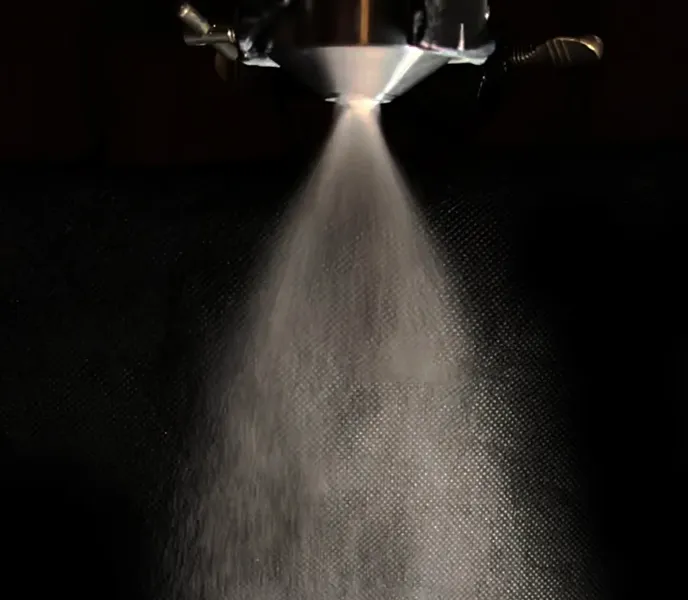
Ultrasonic nozzles for flame spray pyrolysis (FSP) — a fine, stable aerosol from metal nitrate and organometallic precursor solutions feeding directly into flame reactors for nanoparticle synthesis.
The Challenge
Flame spray pyrolysis converts liquid precursors into nanopowders in a single step — but the quality of the product tracks the quality of the aerosol. Pressure and two-fluid atomizers deliver broad droplet distributions and pulsing feed, which translate into wide particle size distributions and poor batch reproducibility. Small orifices clog on concentrated metal salt solutions, and the atomizer must survive mounting close to the flame front.
Our Solution
MicroSpray ultrasonic nozzles generate a fine, low-velocity aerosol with a narrow droplet size distribution — 12–15 µm at 120 kHz, 30–35 µm at 60 kHz — at the low flow rates FSP research demands (well under 1 mL/min up to tens of mL/min). Metal nitrates in water and ethanol atomize without clogging because the flow passage is large and the vibrating tip is self-cleaning. The ThermalSpray™ nozzle variant, with integrated air cooling ports and thermocouple monitoring, operates in the heated zone near reactor flames.
Why Ultrasonic Spray?
- ✓Narrow droplet size distribution for tighter nanoparticle size control
- ✓Stable, pulse-free aerosol feed — reproducible particle synthesis run to run
- ✓Handles metal nitrates and organometallics in water and ethanol without clogging
- ✓Low flow rates (below 0.5 mL/min and up) matched to lab-scale flame reactors
- ✓ThermalSpray™ High-Temperature Ultrasonic Nozzle with air cooling and thermocouple ports for flame proximity
- ✓Compact nozzle bodies integrate into custom reactor rigs via standard adapters
- ✓Droplet size selected by frequency — 48, 60, or 120 kHz
- ✓Sold as standalone nozzle + generator components, not a forced complete system
Supporting Research
Peer-reviewed publications and technical literature relevant to this application area. Links open the publisher's site.
- The Route for Synthesis of Agglomeration-Free Barium Strontium Titanate Nanoparticles Using Ultrasonic Spray Nozzle System
Yoon et al.
Journal of the American Ceramic Society ·
- Silver Nanoparticles from Ultrasonic Spray Pyrolysis of Aqueous Silver Nitrate
K. C. Pingali, D. A. Rockstraw, S. Deng — New Mexico State University
Aerosol Science and Technology ·
Open access · no paywall
- Ultrasonic Spray Pyrolysis for Synthesis of Spherical Zirconia Particles
Song et al.
Journal of the American Ceramic Society ·
Open access · no paywall
Recommended Equipment
ThermalSpray™ High-Temperature Ultrasonic Nozzle
Rated for high-temperature environments with air cooling ports and thermocouples for mounting near the flame
View details →Zero Air Nozzle
Pure ultrasonic aerosol with no compressed air — carrier gas flow stays fully under your control
View details →Liquid Delivery (Dosing Pump)
Pulse-free precursor delivery for a stable, reproducible aerosol feed
View details →Common Questions from Research Groups
Can the nozzle handle aqueous and ethanolic precursor solutions with dissolved metal salts?
Yes. Metal nitrates and other salts dissolved in water, ethanol, or water/ethanol mixtures are a standard use case. The flow passage is much larger than a pressure-atomizer orifice and the vibrating tip is self-cleaning, so concentrated precursor solutions run without clogging. For flammable solvents, the low-velocity ultrasonic process adds no ignition source at the nozzle, but your rig must provide appropriate ventilation and solvent handling.
What droplet sizes are typical at low flow rates?
Droplet size is set by the operating frequency, not the flow rate: roughly 38–45 µm at 48 kHz, 30–35 µm at 60 kHz, and 12–15 µm at 120 kHz. That size band stays essentially constant across the usable flow range, so you can tune throughput without changing the droplet spectrum — the property that makes ultrasonic atomization attractive for FSP.
How close to the flame can the nozzle be mounted?
The ThermalSpray™ nozzle is designed for heated environments up to 300°C at the nozzle body, with integrated air cooling ports and thermocouple monitoring so you can verify the tip temperature in your specific geometry. Exact standoff depends on your reactor's thermal profile — send us your configuration and we'll advise.
Do I need to buy a complete system, or can I get just the nozzle and generator?
Standalone components are the normal way we sell to research groups: a nozzle, its matching generator/controller, and optionally a syringe pump for pulse-free liquid feed. No complete coating system is required — the nozzle mounts into your own reactor or rig using our standard adapters (NPT thread, flange, and flex-mount options).
Do you ship to Europe, and what about lead times and support?
Yes — MicroSpray products are made in the USA and shipped worldwide, including throughout Europe. Contact us for current lead times and shipping options for your country; technical support is handled directly by our engineers via email and video call.
Building a flame spray pyrolysis rig? Ask us which nozzle and generator fit your reactor.
Let's discuss your specific coating requirements.